


PCD Pharma Franchise vs Third-Party Manufacturing
Here is something that does not get talked about enough: two people can enter the pharmaceutical industry with similar goals, similar budgets, and similar work ethic and still end up with very different results, purely because one chose the wrong business model for where they were starting from.
The debate around PCD pharma franchise vs third party manufacturing is not really about which model is better. It is about which model is better for you, given your experience, your capital, your territory knowledge, and how much operational complexity you are ready to take on from day one
This article lays both models out honestly no unnecessary jargon, no bias toward either side so you can read through it and come out with a clear sense of which direction actually fits your situation.
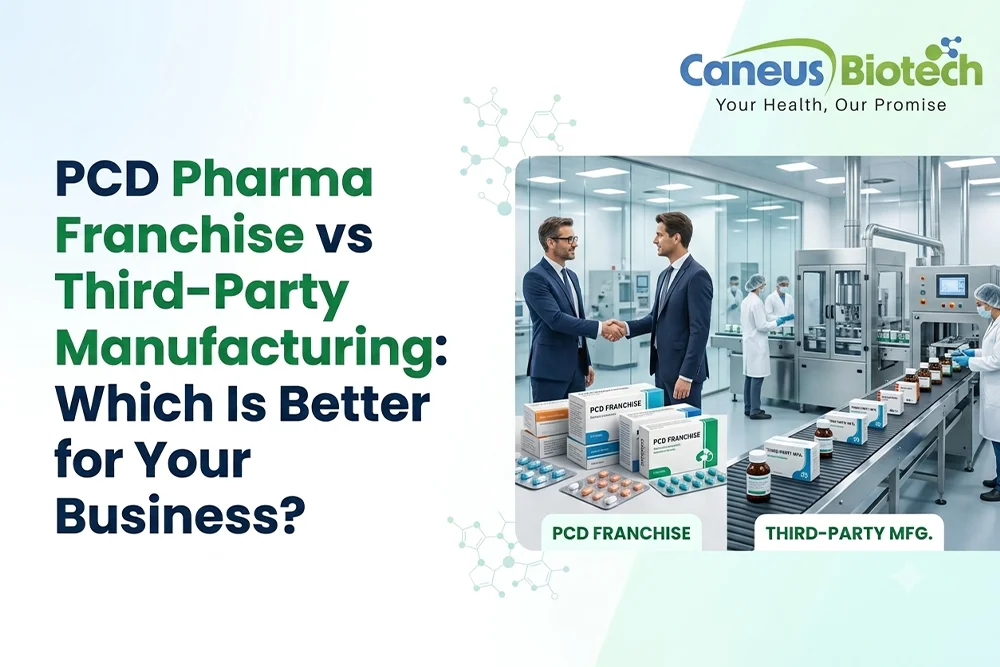
What Is a PCD Pharma Franchise?
PCD stands for Propaganda Cum Distribution. In simple terms, it is a business arrangement where a pharmaceutical manufacturer gives you the right to market and sell its products in a specific area usually a district or defined region under its existing brand name.
You do not manufacture anything. You do not design formulations or manage production. What you do is build relationships with doctors, hospitals, and retail pharmacies in your territory, take orders, and supply products that the manufacturer produces and dispatches to you. Most PCD pharma franchise agreements come with territory protection often called monopoly rights which means the same company will not appoint another franchise partner in your area for the same products. This gives you room to build your market without internal competition eating into it.
For a detailed look at how the Indian pharmaceutical regulatory framework governs pharma distribution, the Central Drugs Standard Control Organization (CDSCO) is the primary authority overseeing drug licenses and compliance requirements for franchise partners.
What Is Third-Party Pharma Manufacturing?
Third-party manufacturing also called contract manufacturing works very differently. Here, you own your own pharmaceutical brand. You decide which medicines to produce, brief a licensed contract manufacturer to make them under your label, and then sell those products in the market under your own brand name.
The manufacturer produces the medicines, but the brand, the packaging, the product identity, and the market responsibility all belong to you. You are essentially building your own pharmaceutical company, just without setting up your own factory.
Third-party manufacturing in India is regulated under the Drugs and Cosmetics Act, and contract manufacturers must hold valid manufacturing licenses issued by their respective State Licensing Authorities under the oversight of CDSCO. As the brand owner, you also carry compliance responsibility for the products sold under your name.
How Each Model Works in Practice
Sometimes the clearest way to understand a business model is to picture what Monday morning looks like.
- Monday morning for a PCD franchise partner: You check which doctors you need to visit this week, follow up on a pending order from a chemist, call your franchise company to confirm dispatch on a reorder, and plan a visit to a new clinic that opened near the district hospital. Your entire focus is on sales activity and relationship management.
- Monday morning for a third-party manufacturer: You follow up with your contract manufacturer on a production batch that was due last week, review the packaging artwork your designer sent, chase a pending drug licence document, coordinate with a logistics vendor for delivery to three distributors, and review whether your latest product launch has started moving in the market. Multiple things are happening at once, and all of them need your attention.
Neither picture is inherently better. But they are very different realities and knowing which one you are actually prepared for matters.
Key Differences at a Glance
| Factor | PCD Pharma Franchise | Third-Party Manufacturing |
|---|---|---|
| Business model | Distribute and market an established brand | Build and sell your own brand via outsourced production |
| Product ownership | Products belong to the manufacturer | Products belong to you |
| Branding | Manufacturer’s brand | Your own brand |
| Manufacturing | Fully handled by the manufacturer | Outsourced but managed by you |
| Regulatory responsibility | Manufacturer holds product licences | You hold your brand’s licences |
| Territory | Monopoly or priority area rights | Self-determined you build your own market |
| Marketing | Supported by manufacturer inputs | Entirely your responsibility |
| Distribution | Manufacturer dispatches to you | You manage storage and outward distribution |
| Operational complexity | Lower focused on sales | Higher brand, compliance, production, and distribution |
| Best suited for | Distributors, MRs, first-time entrepreneurs | Established businesses building a brand |
Product Ownership and Branding
This is where the two models diverge most fundamentally.
In a PCD pharma franchise, the products and the brand belong to the manufacturer. You are marketing medicines that already have a name, a packaging identity, and a regulatory standing in the market. The groundwork has been done. Your job is to build sales volume within your territory using those existing products.
In third-party manufacturing, you own the brand entirely. Every product that leaves the contract facility carries your label and your name. Over time, if you build well, that brand has standalone value a distribution network built around your products, loyalty from prescribers who trust your formulations, and an asset that belongs to your business.
But “over time” is the operative phrase. Brand-building takes consistent investment before it generates returns, and new brands in an established market face real resistance before doctors and chemists start recognizing them.
Manufacturing Responsibility
In a PCD pharma franchise, manufacturing is simply not your problem. Batch consistency, quality control, packaging integrity, shelf life management — all of this sits with the manufacturer. If a batch has a quality issue, the manufacturer resolves it. You are insulated from production-side problems.
The World Health Organization’s Good Manufacturing Practices (WHO-GMP) set the international benchmark for pharmaceutical manufacturing quality. When you partner with a WHO-GMP certified manufacturer for a PCD franchise, you are essentially borrowing the credibility of their quality systems without having to build or maintain those systems yourself.
In third-party manufacturing, the situation is different. Even though production happens at someone else’s facility, the regulatory and quality responsibility for the products sold under your brand is yours. If a product complaint reaches the market, your brand takes the hit not the contract manufacturer’s. This means you need to actively oversee the quality practices of the facilities you work with, not just assume they are up to standard.
Distribution, Territory, and Marketing
For PCD franchise partners, territory is usually defined upfront monopoly or priority rights to a district or region. The manufacturer provides promotional support: visual aids, product literature, reminder cards, MR bags, and sometimes samples. Your marketing effort focuses on building prescription habits among doctors and stocking relationships with chemists. The products you are promoting are already known your job is to drive them in a specific geography
For third-party manufacturers, you define your own market. There are no pre-set territories you build wherever you choose. But you are also introducing unfamiliar products under a new brand, which means your marketing investment has to be higher and more sustained before traction builds. Chemists will not stock a brand nobody has asked for, and doctors will not prescribe a product they have never heard of. This awareness gap has to be bridged through consistent marketing effort over time.
For reference, the Pharmaceuticals Department under the Ministry of Chemicals and Fertilizers provides useful policy context for how the Indian government approaches pharmaceutical distribution and business growth in the sector.
Operational Complexity
A PCD pharma franchise is operationally lean. Sales, order placement, and distribution management — that is largely the scope of your day-to-day operation. Manufacturing infrastructure, product development, and quality systems all sit with the parent company.
Third-party manufacturing adds several layers — finding and vetting a reliable contract manufacturer, managing production schedules, overseeing packaging quality, handling regulatory requirements for your brand, coordinating logistics, and running distribution from the ground up. Each of these is manageable on its own. Running all of them simultaneously, especially in the early stages of a new brand, demands considerably more bandwidth and capital.
Advantages and Limitations of Each Model
PCD Pharma Franchise
Advantages:
- Lower operational complexity from day one
- No manufacturing or production-side regulatory burden on the partner
- Established products with existing market recognition
- Promotional inputs provided by the manufacturer
- Territory protection through monopoly rights
- Faster path to first revenue
Limitations:
- Brand equity builds in the manufacturer’s name, not yours
- Business growth is partly tied to the manufacturer’s product quality and consistency
- Less control over formulation decisions and pricing structure
Third-Party Manufacturing
Advantages:
- Full brand ownership — equity accumulates in your business over time
- Complete control over product range, packaging, and pricing
- Freedom to build distribution in any geography
- Long-term asset value — a brand with market presence has standalone commercial value
Limitations:
- Higher upfront capital requirement for brand development, packaging, regulatory costs, and minimum production runs
- Longer runway before revenue matches investment
- Full compliance and quality responsibility rests with the brand owner
- Higher operational complexity across multiple business functions simultaneously
Who Should Consider a PCD Pharma Franchise?
A PCD pharma franchise tends to work well for people who already understand the field the doctor-chemist ecosystem, how prescriptions flow, what moves in a local market but who want to run their own business rather than work for someone else.
It also works for people who are new to pharma distribution and want to learn the market before taking on the complexity of brand ownership. The model is forgiving in that sense you can start small, build your network steadily, and scale within your territory before deciding whether to expand.
Practically speaking, medical representatives transitioning to independent business, distributors adding a direct income stream, and first-time entrepreneurs entering the pharma sector are all natural fits for this model.
Who Should Consider Third-Party Manufacturing?
Third-party manufacturing makes more sense for businesses that already have a foundation to build on.
If you have an existing distribution network, doctor relationships, and market presence and you want to introduce your own branded products into that network — third-party manufacturing is a logical next step. You are not launching into an unknown market; you are adding your own brand to a network that already trusts you.
It also suits entrepreneurs with prior pharmaceutical experience who understand what compliance and quality management actually involve in practice — not just in theory.
What it generally does not suit is someone who is entering pharma for the first time and looking for a faster path to revenue. The capital requirements, operational demands, and time-to-profitability in third-party manufacturing make it a harder starting point for someone without existing infrastructure.
Can You Use Both Models Together?
Yes and many pharma entrepreneurs in India do exactly this.
The typical growth path looks something like this: start with a PCD pharma franchise to build your territory knowledge, doctor relationships, and distribution infrastructure. Once that base is stable and generating consistent revenue, introduce your own third-party manufactured products into the same network.
By that point, you already know the market intimately which doctors prescribe what, which chemists are reliable, which therapeutic segments have room for a new brand. Launching your own products into a familiar, already-served market is considerably less risky than starting cold.
Which Is Better for You?
The honest answer to the PCD pharma franchise vs third party manufacturing question is: it depends on your starting point.
A PCD pharma franchise is likely the better fit if:
- You are entering pharma distribution for the first time
- You want to reach revenue within weeks, not months
- You prefer lower operational complexity while building market knowledge
- You want manufacturer support for products and promotional materials
- Your primary goal right now is a stable, growing distribution income
Third-party manufacturing is likely the better fit if:
- You already have a pharma distribution network in place
- You have the capital and management bandwidth for a multi-function operation
- Your goal is to build a brand asset with long-term standalone value
- You have prior experience navigating pharmaceutical compliance
Consider running both if:
- You are an established franchise partner ready to expand into brand ownership using the network you have already built
How Caneus Biotech Fits In
a PCD pharma franchise is the right starting point or the right model for where you are right now Caneus Biotech is worth a serious look as a manufacturing partner.
With over 25 years in the industry, WHO-GMP and ISO certified manufacturing, 350+ formulations across multiple therapeutic segments, genuine district-level monopoly rights in writing, and free promotional support for franchise partners, Caneus Biotech is set up to support partners who want to grow their business — not just receive stock.
Explore the Caneus Biotech product range or speak with the franchise team to understand what a franchise partnership could look like in your territory.
Conclusion: PCD Pharma Franchise vs Third-Party Manufacturing
The PCD pharma franchise vs third party manufacturing comparison is not a contest it is a decision framework. Both models have built successful pharmaceutical businesses in India. Both have also been the wrong choice for people who entered them without understanding what they were signing up for.
A PCD franchise offers speed, support, and a lower operational burden making it the natural starting point for most people entering the pharmaceutical distribution sector. Third-party manufacturing offers brand ownership and long-term equity but it demands more capital, more experience, and more operational bandwidth before it pays off.
Know where you are starting from. Choose the model that fits that reality. And build from there.
Frequently Asked Questions
What is the main difference between PCD pharma franchise and third-party manufacturing?
In a PCD pharma franchise, you market and distribute an established company’s products in a defined territory. In third-party manufacturing, you own your own pharmaceutical brand and outsource production to a contract facility. The core difference is brand ownership and the level of operational responsibility that comes with it.
Which model requires less capital to start?
A PCD pharma franchise generally requires less upfront capital. You are not funding brand development, packaging design, regulatory registration for your own products, or minimum production runs. Third-party manufacturing involves higher initial costs before revenue begins to flow.
Can I build my own brand through a PCD pharma franchise?
No. In a PCD franchise, you are marketing the manufacturer’s brand, not your own. If building your own branded pharmaceutical business is the goal, third-party manufacturing is the appropriate model.
Is third-party manufacturing riskier than a PCD pharma franchise?
It involves more complexity and a longer runway to profitability, which can translate to higher early-stage risk — particularly for those without prior pharma experience. A PCD franchise has a faster path to revenue and lower operational burden, which makes the early stages more manageable for most entrepreneurs.
Can I run both models simultaneously?
Yes. Many pharma entrepreneurs use a PCD franchise to build their market presence first, then introduce their own third-party manufactured products into the same network once distribution infrastructure is in place. It is a common and effective growth strategy in the Indian pharma sector.
Who is a PCD pharma franchise best suited for?
Medical representatives transitioning to independent business, first-time pharma entrepreneurs, distributors, and stockists looking to add a direct distribution income are all well-suited to the PCD pharma franchise model.
What regulatory licenses does a third-party manufacturer need?
The contract manufacturer must hold a valid manufacturing license from their State Licensing Authority under CDSCO oversight. As the brand owner, you also need to ensure your branded products meet applicable drug regulatory requirements. For current regulatory guidance, the CDSCO website is the authoritative source.


